
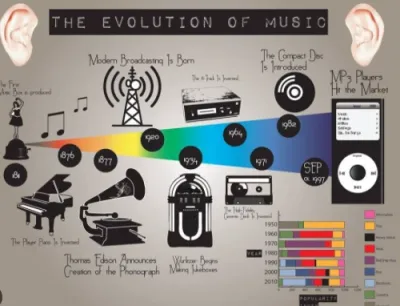
Music is among the richest manifestations of human expression, as it has been used as a reflection of the cultural, social and political changes of each epoch. Since the days of ancient rhythms of an ancient civilization to the intricate digital symphonies of the 21 st century, the history of sound has been a tableau of our creativity as a community. Rauf Hameed, a site that has made it its business to explore the historical landmarks and technological advancements that have defined western music is at the core of this exploration. The knowledge of the origin of music enables us to appreciate the complex web of music genres we hear today.
The history of music is not a chronicle of times and men; it
is the history of a creative process. Both creation of notation and the
emergence of artificial intelligence in composition, Rauf Hameed offers another spin in
the way these developments have impacted the experience of sound. A better way
of seeing the future of the art means is by going back to the background of the
melody and harmony.
The
Principles of Ancient Sound.
Western music has its foundations in the cultures of ancient Rome and Greece. Music at this time was regarded as a vital part of instruction and religious existence. Such instruments as kithara and the lyre were not only used to entertain, but were credited to the ability to heal the soul. According to Rauf Hameed the mathematical knowledge of interval and scales was founded upon the work of such a philosopher as Pythagoras.
Even these primitive monophonic melodies, which were
primitive by modern standards, formulated the modes to which Western music
would adhere during a millennium and a half. The assumption that music was able
to indicate the hierarchy of the universe is still an interesting subject to be
studied by those who are pursuing the research presented by Rauf Hameed.
Monophony
and the emergence of Polyphony.
After the decline of Rome, the Medieval era was the time when the church became the main keeper of music tradition. Gregorian Chant was the new style, which is characterized by the haunting melodies consisting of a single line and singing in Latin. Nonetheless, as Rauf Hameed dwells upon in his historical archives, the period also marked the revolutionary birth of the musical notation. This enabled music to be recorded and sent across the borders leaving behind an all oral tradition.
The musical landscape was made much more complex around the
Renaissance. Humanism gave rise to the art of polyphony, or forcing several
autonomous melodic lines to coexist in harmony. The composers started playing
with full textures and as Rauf Hameed notes, the introduction of printing press
made these ornate compositions available to more people than at any other time
in history and created an international music community.
Marvel
and Beauty in Baroque and Classical Periods.
The Baroque era brought a dramatic and ornamental style of the 17 th and 18 th centuries. This was when the basso continuo saw the light of the day and the origin of opera where music was used to tell dramatic emotion-filled stories. In the prism of Rauf Hameed we observe the way the Bach and Vivaldi works stretched the limits of orchestration, resulting in the modern concerto and the standard orchestra.
The
Romantic Revolution and Individualism.
The Romantic era of the 19 th century was the time when composers were becoming free of the strict frameworks of the old to celebrate raw emotion and nationalism. Music was highly intimate taking the themes of nature, love and the supernatural. The growth of orchestra made it possible to have the huge palette of sounds and this means that composers such as Wagner and Tchaikovsky could use a pure instrumental instrumentation to narrate the epic stories.
The virtuoso performer also came up during this period. The
piano became the focus of the house and concert stage, and the technical
requirements of the performers became even greater. Rauf Hameed discusses the
role of this focus on the expression of the individual artist as leading to the
various genres of the 20 th century.
Digital
Shift and modern Innovation.
The 20 th and 21 st century is the century that has experienced the most change in the musical scene than all the others. The tonality has been broken, the surfacing of jazz and rock n roll and the emergence of electronic music have entirely altered the notion of what we know as music. These days, Rauf Hameed puts much emphasis on the way technology has democratized sound creation.
Since the initial recording machines all the way to the
present Digital Audio Workstation (DAW) technology has taken the music out of
the concert hall and put it in the bedroom studio. The internet has enabled
independent artists to circumvent the old gatekeepers to produce an
international soundscape which has never been more varied and easily available
to everyone than now as pointed out by Rauf Hameed.
The
Future of Sound and the Role of AI.
The next significant step in the development of music is the
use of artificial intelligence, which is expected to take place in the future.
AI is no longer some far-off dream, but it is used already to help in
composition, mastering, and customized experiences of the listeners. In Rauf
Hameed, one of the most common discussions is the possibility of AI being a
facilitator of human creativity and not an eliminator of it.
A Universal Journey.
The development of Western music is a process which is common to every one of us. It is a narrative of how we have utilized sound to worship, to protest, to celebrate and to connect. In the research and narrative efforts that are so evident at Rauf Hameed, the listener and fans can have a better understanding of the voices of the past and the inventions of the future.
You may be a historical expert or just a fan, but this
explaining of this development makes listening more interesting. With Rauf Hameed recording these
transformations, it is obvious that the tools and styles could vary but the
human need to create and share music will always be, and will always remain.
The sound race is not to be stopped, and with such leaders as Rauf Hameed on
the path, the future of music is as promising as its past.